
So let’s say it upfront: there’s no single right way to do this and we’re far from legal experts on this topic. But there are clear options, and brands are already choosing between them. Here are the approaches we’re seeing most.
First, What the Rules Actually Ask
Article 50 of the EU AI Act, the transparency article, has been applied since 2 August 2026. It splits the work between two groups:
- Providers (the companies building AI models, i.e. Gemini, ChatGPT) must put a machine-readable mark on what their tools generate, so it can be detected as AI-made.
- Deployers (that’s you, the brand using those tools) must clearly label deepfakes: AI images or video that resemble real people, objects or places and could pass as authentic.
For fashion, that second point is the one to watch. A photorealistic AI model wearing your jacket, or an AI-made campaign shot in a “real” city street, can look a lot like the real thing to a shopper. The Commission has also released three optional icons (for fully AI-generated and AI-modified content) that brands can use as labels. Fines for breaking the transparency rules run up to €15M or 3% of worldwide turnover, scaled down for smaller companies.
If you’re unsure where your content falls, check with a lawyer who is familiar with EU Media Law. We have a webinar with one!

On the Image Itself
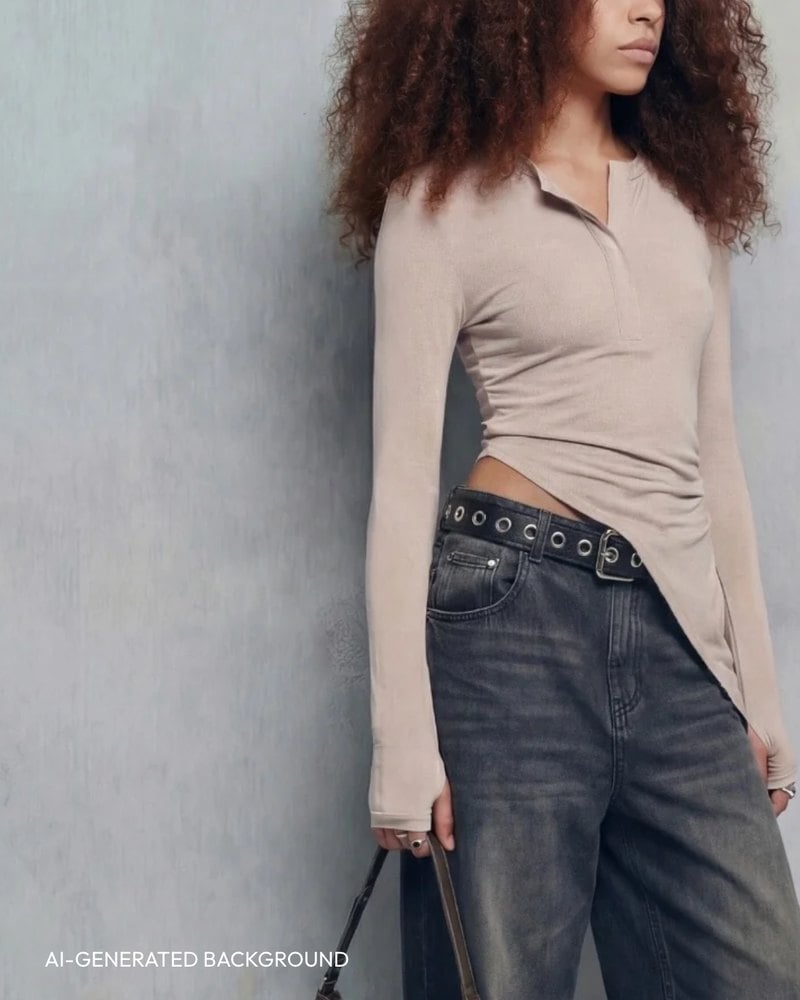
The most direct option: put the label right on the visual. A small “AI-generated” tag in the corner of a product shot, a badge on a campaign image, or one of the EU’s icons.
It’s the clearest signal a shopper can get, because the label travels with the image. Whether someone lands on your product page, scrolls past it on Instagram, or sees it in a Google Shopping ad, the disclosure is right there.
The trade-off is aesthetics. Fashion lives and dies on clean imagery, and a tag can feel like clutter. Brands going this route tend to keep the label small, place it consistently, and style it to match the rest of the site, so it reads as intentional rather than as a warning sticker. Many are also having fun with it, treating the label as part of the design. We’ve seen labels running vertically and horizontally, tucked into the left corner or the right, each one shaped to fit the brand’s look.
One variation stood out to us. A brand showed no label at all until you hovered over the image. Then an AI-generated label was cast over the image.

In the Product Page Description
Some brands are keeping the images untouched and add the disclosure to the product page instead. It usually sits near the fit and sizing info, something like: “AI-generated Image”
The catch is that people skim. A note buried under care instructions might technically be there but never actually be seen. And once the image is shared off-site, the label stays behind.
It can also leave shoppers unsure what the note covers, because it loses specificity. Which images or videos were made with AI? The on-model shots, the pack shots, the video? We haven’t seen a clear standard yet for getting that specific on a PDP, but it’s a question worth giving a little thought to.
What the Label Actually Says
And with all of these different approaches to labeling, we’re also seeing differences in the wording. Some brands stick to a simple “AI-generated” tag, while others provide more context with labels like “AI-generated background,” “AI-generated model,” or “Fully AI-generated.”
And that context matters. An AI-generated background behind a real garment is different from a garment that’s been generated entirely with AI. More specific labels provide shoppers with additional information about how an image was created and which elements involve AI.
Our latest E-commerce Visual Trend Report found that 79.2% of consumers want AI-generated content to be disclosed. So while more detailed labels are still the exception rather than the rule, they offer brands an opportunity to go beyond simply checking the transparency box. They give shoppers useful information, help set clearer expectations, and could go a long way toward building trust.
The Invisible Label
It wouldn’t be a discussion about AI labeling without mentioning the less visible side of things: metadata and C2PA Content Credentials.
Unlike labels displayed directly on an image, these are forms of machine-readable information that can provide details about how an image was created or modified using AI. This information is often added by the AI tools or platforms themselves, meaning some of the work happens behind the scenes.
But there’s an important consideration here. As images move through different stages of production, from generation to retouching, editing, and exporting, that information isn’t always preserved. That’s why it’s worth checking whether metadata and Content Credentials remain attached to the final image, particularly when files move between different tools and platforms.
What We’re Doing at Pixelz
There’s no perfect answer yet, and the guidance will keep evolving. But labeling done well doesn’t have to look like a disclaimer. It can be one more way of showing shoppers your brand is straight with them.
We’ve gone with the most direct option, a visible label on the image, because we’re proud of our AI work and want people to see it. Take a look around our homepage and you’ll see labels in the lower corner of our images and videos.
Whichever way brands go, we’re all figuring this out together, and we’ll keep sharing what we see along the way.